Wednesday, 22 January 2014

Selinous

If arriving by sea, Selinous would have been a wondrous sight.  It sat on a bluff between two rivers and extended inland.  The first group of temples rose up within the city on the Acropolis, overlooking the sea.  The second group stood to the east across a small estuary, the huge Temple E, the massive Temple G and their smaller neighbour, Temple F.  Temple G was the largest planned temple in the Greek world, measuring 164 x 362 feet, it was to have eight columns on the facade and 17 on the sides.  Temple G was unfinished as the city was sacked by the Carthaginians in 409 BC.  Currently it is a giant rubble pile due to an earthquake in the Middle Ages.

You have to imagine the astonishing view of three temples in parallel sitting on a hill.  The view from the Acropolis would have been an oblique view as was typical of the Greeks.  The temples have been named with letters as there is ongoing debate regarding which deity the temples were dedicated to.

The Acropolis was ringed by a huge defensive wall and had three temples.  Some columns of Temple C have been reconstructed, apparently, a few of the columns were monolithic or cut from one piece of limestone. The city was laid out with two main streets crossing and the lesser streets laid out in a grid pattern.

After the Battle of Himera in 480 BC, where the Greeks from Siracusa and Akragas defeated Carthage, Selinous allied with Siracusa against Carthage.  In 409 BC, Segesta, the enemy of Selinous, asked Carthage for assistance in attacking Selinous.  After only nine days, Selinous fell, the city was sacked and destroyed and the inhabitants sold into slavery.

A short time later, refugees received consent from Carthage to refound the city, it remained under Carthaginian control and was inhabited by a mixture of Greek and Punic people.  The Carthaginians made some alterations to sanctuaries to suit their deities.  In 250 BC, the city was abandoned and the people transferred to Lilibeo (Marsala).

West of the Acropolis is a series of shrines, the Sanctuary of Demeter Malophorus, enclosed within a wall forming a sanctuary reserve.  Just outside the gateway is a well, this signifies the Kallichoros well beside the gate of the Sanctuary of Eleusis near Athens, beside which Demeter collapses in despair, over the disappearance of her daughter Persephone.  Left of the entrance is the shrine of Hekate who was the guardian of the Eleusinian shrine.  In the centre of the sanctuary is a grand altar, behind the altar is the temple, much of the wall is still standing, it was a large central chamber with an outer room at the front and an adyton (an inner chamber) at the back.  The Carthaginians altered the temple and it was the cult of their goddess Tanit.

It was a beautiful sunny day when we set out for Selinous, which is the Greek name, today it is called Selinunte.  This is a great time of year to travel as the archaeological parks are pretty much deserted, so we have the place to ourselves most of the time.  When we got to the ticket area of Selinous, the three workers communicated to us that they only wanted coins, we were perplexed.  We figured out that they could not make change for a 20 euro note, which is utterly hysterical.  I fished around for all of my coinage and came up .70 short.  They ended up making our change among themselves, we walked away chuckling, this is just the way it is here and we just have to laugh about it.  They didn’t provide a map so John had to head back to the car and get our guidebook, we would have been sunk without it.

The great thing about Selinous is the laid back atmosphere of the place.  It was the first archaeological site where we could actually enter a temple, which is quite something.  The interior space really defines the exterior and you do not experience that when looking in from the outside.  Temple E (first pics), felt even more monumental from the inside.  We could ramble through the rubble pile of fallen down temples at will, it was fabulous!

The Sicilians have the best road signs, spectacular, actually.  This is the case on the main roads, apparently,  it is another story on secondary roads.  They give loads of warning prior to a turn, signs are everywhere.  But the archaeological parks, hahahahaha, not a sign to be had, hence the need for a really good guidebook.  After visiting the sanctuaries, our guidebook said there was an antiquarium in a farmhouse that has artifacts from the sanctuaries.  There were a couple of cars parked there so we figured it must be staffed.  There was absolutely no signage on the building at all, in any language.  We saw footprints leading up some steps to a door so we went up the steps and as John opened the door, we were met with a chorus of Sicilian or Italian, not sure which, all arising, loudly, and simultaneously, from about three or four men who were in there with a televison blaring.  We concluded that we had the wrong door, then a guy who spoke some English came out and sort of directed us to the other side of the building.  When we rounded the corner, he was there waving us on.  He turned on the lights of the small museum and hung around while we looked at the artifacts.  We noticed there were stairs leading up to the room with the other men and the television.  We walked away laughing our heads off.

Temple E reconstructed, I stood in one of the flutes on the columns, it is that large.


Look at that view to the sea.

The view from the Acropolis, imagine three of them in parallel.  The other two dwarfing Temple E.

Wall around the Acropolis.

Temple C on the Acropolis, reconstructed.

Great example of a fallen column with capital.

This is the view down the main north-south street to the north gate of the city.

The view from the north gate back to the sea.

Artifacts in the antiquarium.

Well in front with Temple of Demeter Malophoros in background.

Temple of Demeter Malophoros (The Bearer of Fruits).

After spending forever at Selinous, we drove to the Cave Di Cusa (Cusa Quarries).  There was a long, deep bank of limestone that was compact enough that the temple builders could detach pieces large enough for the gigantic Temple G at Selinous.  The quarry was in use from the 6th century BC until the destruction of Selinous in 409 BC.  Work at the quarry came to an abrupt halt with drums in several stages of completion, the drums were abandoned where they lay.  It is rather disconcerting to think about all that work at the quarry coming to nothing.

It is thought that wooden frames were placed around the drums and they were then transported on wheels of wood reinforced by iron bands.  The load was pulled by oxen to Selinous, a distance of 10 km.

This is a wonderful area to visit, there was nobody there until an Italian came and took photos but he did not stay long.  The quarry is next to olive groves and vineyards on one side and grass (very prairie like) on the other side.  It was only us and the birds and some wonderful old olive trees.

We could fit into the gap and walk right around the column.


Tuesday, 21 January 2014

History of Sicily

This is a rather rudimentary history of Sicily as I tend to focus on historical events that interest me.  There was a section discussing a few battles between Hannibal and the Romans, but I cut them out as this would go on and on.  The Sicilians are a real mix of cultures, they have their own Sicilian dialect but they also speak Italian, not that we would know the difference.  We communicate by hand signals and a few necessary words.  It is amazing how well hand signals actually convey meaning that is understood.

Sicily is a fertile land in a strategic position in the Mediterranean, close to the Italian mainland and not very far from the coast of North Africa.  Sicily attracted migrants and conquerors intent on a new homeland.  Sicily’s history is one of foreign domination, much to the detriment of her people.  The list of invaders is long: Phoenicians, Carthaginians, Greeks, Romans, Byzantines, Arabs, Normans, French, Germans, Spanish and Italians.

Based on the archaeological evidence of flint tools, modern humans likely occupied Sicily some time after 30,000 BC.  It was not until after 10,000 BC when the land masses that we have today were established, that sites of human habitation multiply.  Palaeolithic rock drawings in caves date to 9,000 BC.  Humans in the Palaeolithic were hunters, in the next period, the Mesolithic, there is evidence of the consumption of wild fruits and shellfish, then a substantial increase in the consumption of fish.  The age of plying the Mediterranean sea began long before the move to village settlements and agriculture.

In the Neolithic age, there was no evidence of population pressure to push the people into agriculture, the transition took place slowly.  Pottery is in use and the shift from living in rock shelters to establishing agricultural villages takes place.

When the navigation of the Mediterranean opened up, the flow of ideas, knowledge and trade took place over large distances.  There are no metal resources in Sicily, by 3,000 BC, the use of copper is evident, which would have come from the Aegean.  Bronze age artifacts came from Greece and the Aegean as well.  These metals were made into weapons and those bearing weapons would have arrived in Sicily.  The population was driven into the hills into new towns founded by Sicilean kings.

When the Greeks began to set up colonies in the 8th century BC, they claimed to have found early inhabitants:  the Sicels (from Italy) in the east, the Sicans in central Sicily and the Elymians in the west.  While the Greeks were settling or slightly before, the Phoenicians were also settling.  Carthage was founded on the coast of North Africa and settlements were founded in the west of Sicily,  Panourmus, Solus and the island of Motya.  The Carthaginians had good relations with the local Elymians.  The Elymians were often in conflict with Selinus.

The Carthaginians and the Greeks were often in conflict, during the Battle of Himera in 480 BC, Greeks from Siracusa and Akragas fought and defeated the Carthaginians.  To celebrate the victory, the Greeks would build new temples with the slave labour of the defeated.

Greek tyrants emerged as rulers, they destroyed cities, founded cities and repeatedly uprooted and moved tens of thousands of people to new cities.  They concentrated wealth for themselves and built many temples.  The democratic city-state of Greece never took hold; there was never a sense of community which was necessary to establish a self-governing city-state.  There were too many outside threats, too much uprooting of the people and too many mercenaries from Oscan-speaking Italy who fought for the tyrants and then raised havoc after their service ended or when the tyrants lost power.

The Carthaginians fought the Romans in three Punic Wars, the First Punic war lasted 25 years, from 264 - 241 BC.  The ruler of Siracusa and its dependent states in Sicily allied with Carthage, but soon switched to support the Romans, therefore, avoiding the horrors of the First Punic War.  The Romans defeated the Carthaginians, ending their control of western Sicily.  The Carthaginians were exiled and had to pay a large indemnity to Rome.  The First Punic war was a disaster for western and southern Sicily; when the Romans captured the Carthaginian cities in Sicily, the population was sold into slavery, 25,000 from Akragas alone, and the cities destroyed.

Sicily became a Roman possession, the Carthaginians built an empire in Spain and would battle the Romans again over control of Iberia and the western Mediterranean in the Second Punic War 218 - 201 BC.  From their base in Spain, Hannibal crossed the Pyrenees, marched across southern Gaul (France), crossed the Alps and entered Italy from the north after a march of five months.  The Gauls of the lower Po Valley (northern Italy) joined the Carthaginians.  Hannibal was a military genius, he used deception and brilliant tactics to defeat and destroy the Roman armies that greatly outnumbered him.  Hannibal moved through Italy and was in the south when the Romans tried again to defeat him.  Sicily was in a strategic position as she stood between the victorious Hannibal in southern Italy and his home base in Carthage.

The Sicilians were not pleased with Roman rule so they sided with Carthage, even Siracusa came onside.  Siracusa was under siege by the Romans for two years, but it finally fell in 212 as the result of treachery by the nobles.  The Roman soldiers looted the city and the Roman commander stripped the city’s temples and public buildings of vast quantities of statuary and paintings, he shipped these to Rome.  The last Carthaginian city to fall to the Romans was Akragas in 211, again, the population was sold into slavery.  The war dragged on until Hannibal was defeated in North Africa.  Carthage was destroyed as a power; thus, the Romans had control of the western Mediterranean.  Sicily lost what independence she had left and her economic output was directed to Italy.

Sicilians spoke Greek, not Latin; to the Sicilians, Rome was a foreign power.  The Sicilians used the Greek calendar, their festivals were Greek and the architecture was still Greek.

The Romans took 1/10 of the wheat and barley crop and shipped it to Rome, the Sicilians were not free to export their production, it had to go to Italy unless the Roman Senate permitted a special license, the Romans could take a second tithe at a price set by the Senate.  They implemented a 5% duty on all goods shipped out of a Sicilian harbour; there was a tax on wine, fruit, olives and vegetables and a pasture tax.  Prices were fixed by Rome for the maintenance of the Roman governor and his staff and the communities in Sicily had to provide ships and crews to protect the harbours from pirates.

Land in Sicily was confiscated from declared enemies and given to Roman veterans, Roman citizens or other ‘allies.’  As a result of wars in Greece and in the east in the 2nd century BC, huge populations were carried off by the armies.  What people remained were bought by slavers and sold to buyers in Italy and Sicily.  With the supply of free labour, the wealthy landowners increased their holdings of farms and pasture land, Sicily became a land of large estates.

The Slave Revolts

Many recent arrivals of slaves in Sicily were Greek speaking and of high education and birth, these slaves could organize and plan.  The treatment of slave herdsmen, shepherds and agricultural labourers was horrendous; they were branded, chained, beaten, undernourished and overworked.  The urban slaves, craftsmen and domestics were better off; therefore, most of the insurgents in the slave revolts came from the lower ranks, but were led by slaves of the higher ranks.

The history of the slave revolts is rather sketchy, it likely started in 139 BC in Enna, where the slaves of the exceedingly rich Damophilus of Enna, decided to kill him.  They asked Ennus (a recent arrival and charismatic individual who thought of himself as a prophet) if the gods approved of the plan to murder Damophilus.  Ennus led a band of slaves into the city and a riot ensued.  After some consternation among the slaves, the leaders of the riot killed Damophilus.  Ennus was proclaimed king and began to rule.  Damophilus’s wife was killed by her own slaves, the daughter, who had always tried to help the brutalized slaves, was spared.  All slave owners were either killed or put in chains to work in arms manufacture.

Meanwhile, another revolt began in near Akragas, the two leaders joined forces and may have amassed an army of 60,000 to 70,000.  The revolt was not crushed until 132 BC, when the Roman governor sent in trained Italian soldiers.  Many revolting slaves were killed and then life went on as before with new slave owners replacing those killed in the revolt.

In 104 BC, when Rome asked for military assistance from a client-king in Asia Minor, the king replied that no young men were available because the slavers, who were protected by Roman officials, had taken them all.  The Roman Senate then ordered the release of ‘allies’ reduced to slavery.  In Sicily, huge numbers of slaves appeared before the governor demanding their freedom.  He granted freedom to about 800 slaves, overwhelmed by the numbers, he told the rest to return to their masters.  The slaves revolted and soon after more slaves joined the revolt.  The Romans defeated the slaves again and the status quo resumed; agricultural production recovered and slaves did the work.

Caesar had defeated Pompey during the struggle to rule Rome.  After Caesar was assassinated in 44 BC, Pompey’s son Sextus, who was based in Sicily, took control of the sea with the aid of slaves who crewed the ships.  Sextus prevented the transport of Sicilian grain to Rome.  Rome agreed to recognize Sextus’ authority in Sicily and promised to free the slaves in his service; therefore, Sextus lifted the blockade.  War resulted and Sextus was defeated, Caesar’s great-nephew and adopted son and heir, Octavian, the first Roman emperor, was merciless.  The slaves went back to their owners and Sextus was killed.  Large land holdings were confiscated and retained by Imperial Rome, smaller holdings were granted to Legion veterans who were loyal to Rome.  Thus, began a concentration of Latin speaking people in Sicily for the first time.

During the Roman Imperial period, the Sicilians had no interest in advancing themselves in Roman government and society, as often happened in southern Gaul (France), Spain, North Africa and Asia Minor.  Few Sicilians joined the legions or entered the imperial career service.

Sicily caused no trouble for Rome until the Vandals, a Germanic tribe, took military control in 468 AD.  The Vandals sold Sicily to the leader of the Ostrogoths who had taken Italy.  During this period, the Roman Empire in the west was in a state of crisis and collapse.  The Visigoths sacked Rome in 410 AD and by 476, the once great western Empire was a collection of barbarian kingdoms.  The eastern Roman Empire (Byzantine) based in Constantinople (Istanbul) was much stronger and endured until 1453.

The Byzantines and Goths fought over Italy and the Byzantines fought the Persians in the east.  In 535, the Byzantines defeated the Goths in Sicily in a relatively easy conquest.  In 663, the Byzantine Emperor Constans moved the capital to Siracusa after more than 300 years in Constantinople.  This lasted for only five years,  Constans was assassinated in 668 and the capital was moved back to Constantinople.

The Byzantines controlled Sicily until the Arab conquest began in 827, the war went on for 50 years as Constantinople fought hard to retain her last western outpost.  The war brought famine and plague to Sicily.   Sicily likely suffered more during the Arab wars than during the two  Punic Wars.  Siracusa fell in 878 and this marked the end of ancient Sicily.  The population of Siracusa was massacred and the city looted.

The Arabs did much to benefit Sicily and their influence is abundantly evident today.  The Arabs were skilled farmers from Mesopotamia, they transformed Sicily by introducing and planting citrus fruits, sugar cane, cereal crops and palms.  They also processed food and by some accounts, invented spaghetti.  Prior to this, pasta was made with soft grain flour which would not keep.  Dry pasta could only be made with the paste from hard durum wheat, which at the time of the Arab conquest, was only farmed in Sicily and other hot countries of the Mediterranean.  Most of the durum processed in Sicily today comes from the Canadian prairies.

Arab design is visible in architecture, old historic town centres, ceramics and mosques.  The cuisine of Sicily has many Arab influences as well, couscous is a popular dish in western Sicily.

The next conquerors were the Normans in the 11th century, the Normans drove out the emirs but did not kill or expel the Arab people.  The Normans adapted to the Arabic, Latin, Greek and Jewish traditions already present in Sicily.

After the Normans came Swabians, then Angevins, Aragonese (Spanish) and then the Bourbons.  In 1860, Garibaldi and his band landed in Sicily and defeated the Bourbons, this led the way to the unification of Italy.  It can be argued that unification benefited the industrial north at the expense of Sicily and southern Italy.  Sicilians suffered greatly from poverty and hunger, between 1895 and 1910, half the population emigrated to the USA and Australia.

Had a bit of a breezy and rainy day today, this is a really nice beach in southwestern Sicily.  We wanted to hike along the beach but the weather was too brutal.


Flowering shrub in Sciacca.


The area is home to many ceramic artisans, these large ceramic pots are all over the town.

Monday, 20 January 2014

Segesta

Today was a travel day, off to Sicily.  We got up at 5:00 a.m. to catch a fast train to Naples.  What a difference a fast train makes; they are really smooth, you hardly know you are moving, that is the way to travel.  There is no fast train to Sicily, only an Intercity train which takes 8 hours so we opted to fly.  I booked a cheap fare on a budget airline ages ago to fly from Naples to Palermo.

At the train station in Naples, we found the airport bus and were off to the airport.  Security is easy, you scan your boarding pass and that gets you into the security area, you don’t have to remove shoes, you don’t have to take the laptop out and there are no ridiculous body scanners.  A security guy then re-scans the boarding pass and has a look at your passport, then through the metal detector you go and that is it.  The departures section of the airport is really nice.

Once again, everybody goes outside, boards a bus and the bus transports the passengers to the air plane which is sitting out on the tarmac.  It was pouring rain in Naples and quite windy.  The first time in the history of flying, our luggage was at the baggage carousel in Palermo airport before we were.  Then we headed outside and found a shuttle to the car rental place and we got our car, a tiny Fiat 500 which is perfect for the roads we will have to negotiate here.

Okay readers, here we go.  There are more archaic Greek temples in Sicily than in any other part of the ancient Greek world, so you know what is in store.  The magnificent temple at Segesta was built by the Elymians, who were already inhabiting the western part of Sicily when the Greeks arrived in 8th century BC.  The Elymians seemed to be declaring a cultural association with Greek heritage, it is said that the Elymians considered themselves to be fugitive Trojans but that is disputed among scholars and is unlikely.  The Elymians were constantly at war with Selinus, another city with numerous Greek temples.

The temple was never finished but is wonderfully preserved.  It sits on a hill and faced the city of Segesta with  Mt Bernardo in the background.  The view from the temple is toward a valley and it sits on the edge of a deep ravine.

Even though the wind was unreal, we had to stop at Segesta, as it was on our way to our apartment which is in the south of Sicily in Sciacca (pronounced Shak-ah).  Recall that the Greeks were very particular about siting their temples, well, the temple at Segesta is in the most breath-taking site imaginable.  Its place in the landscape is only rivaled by the Parthenon in Athens which sits on the Acropolis.

After we got our tickets, the bus driver came up and asked us if we wanted to get on the bus to go up the large hill to the Greek theatre, we said no, we would walk up.  He said, it is 2 km!  We said that was okay, we would walk up.  So we did, in a gale force wind.  Our timing was pretty good as it started to rain just after we visited the theatre.

Segesta Late 5th Century BC

What is missing from these columns?  This is an incomplete archaic Doric temple.

The squares on the stylobate are called bosses, they are used to shift the stone blocks and are normally removed after construction is complete.


A few km up the hill is the old Greek city and this spectacular Greek theatre, mid 3rd century BC.


Sicily has amazing bridges, rather than dropping down to drive through a valley, the road stays up top.

We are staying in the southwest of Sicily.  A supermarket was a short walk away so we headed over there to get some groceries as it is so handy and we are wiped-out from a long day.  When you shop for vegetables, you wear plastic gloves to handle the food, then you bag it and weigh it yourself.  You punch in the picture of the vegetable and it prints out a price sticker which you affix to the bag.  A local saw us trying to find the fennel and then helped us with every vegetable until he clued us in that the number to punch in is also written near each vegetable along with the price per kg.  Fennel grows wild here, it is everywhere at Segesta.

Saturday, 18 January 2014

Sentiero degli Dei (Pathway of the Gods)

In legend, the gods came down to this pathway to reach the sea on the Amalfi coast.  The Sirens would sing their beautiful songs to lure sailors to come near.  But the Sirens resided beyond impassable reefs and the sailors would shipwreck.  Ulysses was warned about the Siren’s songs while on his journey, so he ordered his crew to fill their ears with beeswax so they would not hear the songs.  He also instructed his crew to strap him to the mast so that he could hear the songs of the Sirens but not sail toward them.

We took the bus to Amalfi and then had to get another bus up the mountain to Bomerano.  We had 45 minutes to wait so we had a cappuccino and found out where the bus stop was.  We did not have a clue as to where to get off the bus as there are no town signs, it is all one area called Agerola.  Having been tipped off by our hiking book, I wrote out, in Italian, a note for the driver to let us know when we reached the correct stop.  Sure enough, when we got to Bomerano, he yelled out Bomerano!  We got off and another two people got off, who happened to be Australians who were planning on the same walk as we were.  I asked them if they knew where to get off and they said no, so I don’t know how they planned to get off at the proper bus stop.

We headed off on the ‘Pathway of the Gods’ from Bomerano to Positano.  It was a really easy hike and only took us about 3 hours.  There were a couple of options to get from a town high in the mountains down to Positano which is a seaside resort, well, a stacked up the mountain resort.  We opted out of the path with 1,700 steps straight down the mountain and opted for a walk to the next mountain town which cut out some steps, although there were enough steps to negotiate.  We are getting legs like the locals though, and everything is very easy now.

When we got to Positano, we dropped into a shop to buy bus tickets back to Salerno, this would involve a bus change in Amalfi.  The shopkeeper said the bus to Amalfi was closed, I thought we were having a communication break-down so was showing him my bus schedule and he kept saying it was closed.  Then a couple of Americans came in and said that they were just told the road was closed due to a landslide.  We had to take the bus all the way to Sorrento, which is in the opposite direction and we knew there was no bus from Sorrento to Salerno and would have to take a couple of trains.

A large group of us waited for the bus which was very late.  It did arrive and we were off to Sorrento.  We only had a cup of tea for breakfast and a cappuccino in Amalfi and never did get a chance to eat our lunch so were starving.  When we got to Sorrento, we headed to the Tabacchi shop and got train tickets to Pompeii, then we immediately caught the train.  When we arrived in Pompeii, we had to walk to a different train station on the Salerno line to get back to Salerno.  Luckily we knew everything since we have figured out the train/bus system and since we had already been to Pompeii, we knew which direction the Salerno line was, so we walked over there and got tickets and caught the next train.  Our timing worked out perfectly and we got back to Salerno.

We googled the road closure and found out the landslide happened on Monday!  There were other foreigners on the hike going in the opposite direction and they would have experienced the same problem only they would have been in Amalfi, with no way of getting back without taking some bizarre route like we did.

Hut in the Hills

Praiano, note the awesome hairpin turns near the bottom of the pic.

Amalfi Coast

Town of Nocelle up top, Positano below, both were our destinations

Positano

Amalfi Coast and Nocelle

Pertuso or pierced, giant hole in the rock above Monte Pertuso

No!  More steps.  These were down, thankfully.

Positano, a very pretty town.

Friday, 17 January 2014

Naples - City of Chaos

We took the train to Naples today, Naples is quite the place.  It is busy and crazy and gritty; people tend to either love it or hate it.  It is reputed to have the best coffee on the planet and is the home of pizza.  There is constant commotion, vespas and other small motorcycles whizz around and cars cluster with horns honking.  To cross uncontrolled intersections, one has to keep a constant pace so the motorbikes will time it to go around you, if there were any locals about to cross, we made sure to just cross with them.  Cars are parked everywhere, the sidewalks are clogged with people and vendors selling stuff; so it takes a bit of concentration to walk in Naples.  We like to walk to all of our destinations as we get to experience the place much more than when taking a metro.

We should have taken along our compass, everything looks so easy in google maps until we were on the street and didn’t know which direction we should really be going, as we never saw street signs.  Somehow or another, we tend to have a sense of direction and got ourselves turned in the correct direction and made our way to the Naples Archaeological Museum.

What a museum it is, there is an entire section on Pompeii.  Many of the most important artifacts from Pompeii are in the museum.  The building itself is beautiful with marble floors and huge windows.  There is also a lot of wonderful sculpture.  One really has to know mythology to be able to interpret a lot of the wall paintings and sculpture as the Romans evoked myth in their painting and copied Greek sculpture.

We are not knowledgeable at all when it comes to myth, sculpture and painting.  We only know the four styles of Roman wall painting because of our study of Pompeii and Herculaneum.  Italy overwhelms, there is just too much.  Therefore, we had to decide early on what to focus on and we decided to concentrate on Roman architecture and archaeology, which led to Greek temple architecture as that is where it all started here in the south of Italy.  Nevertheless, we were taken with the sculpture as we have never seen anything like it before.

Mosaics

We may as well start with an astounding example of a mosaic made with tesserae, which is tiny stone.  This is the famous ‘Alexander exedra’ from the floor of the tablinium in the House of the Faun in Pompeii.  There is a copy in the house in Pompeii right now and the original is on the wall in the museum.  It is thought to be a copy of an earlier Greek painting that was lost, painted ~ 300 BC.  The mosaic depicts the battle of Alexander the Great (Hellenic King) and the Persian King Darius, at the Battle of Issus, where Alexander defeated Darius.

Darius, in his chariot, is in retreat.  His horse is wheeling around to flee but both Darius and his horse are looking at Alexander with fear in their eyes.  The soldier on the ground can see his own face reflected in his shield.  The detail of Alexander's hair is extraordinary when you consider this is made of tiny stones.


Mosaics


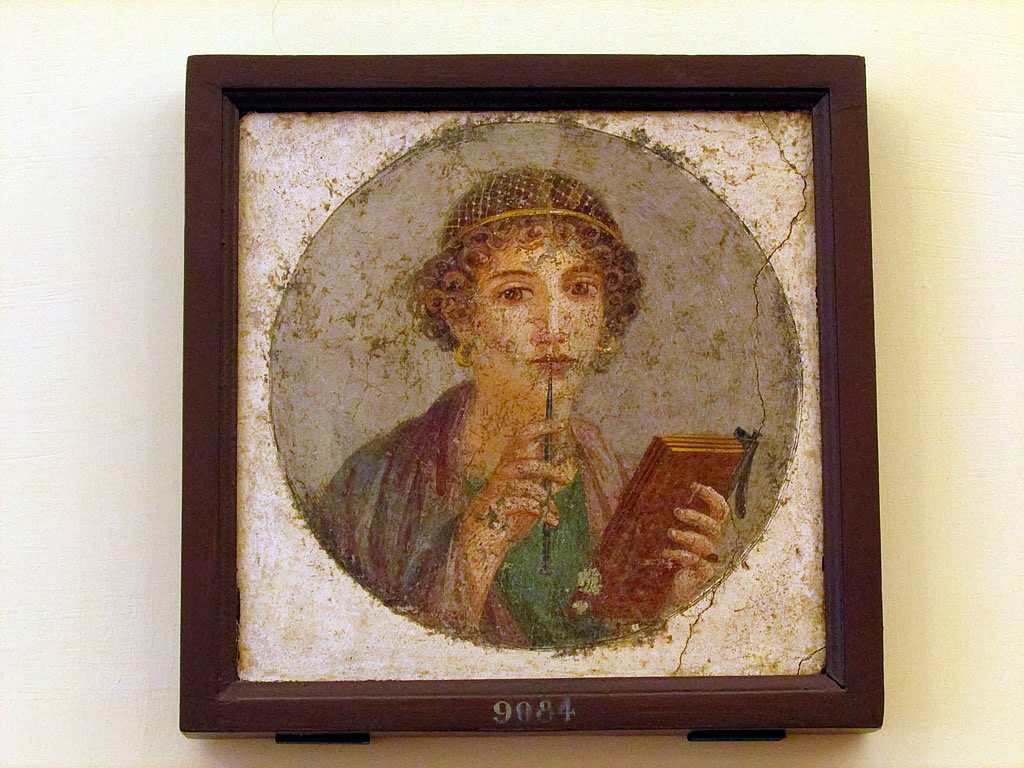
Painting from Pompeii, Woman with a Stylus, Middle of 1st Century AD

Farnese Collection of Sculpture

The Farnese Bull was situated in the Baths of Caracalla in Rome, it is a copy of a sculpture from the Greek island of Rhodes.  This was sculpted out of a single block of marble.  It depicts the myth of Zetos and Amphion, sons of Antiope, tying Dirce to the horns of a raging bull in revenge for the cruelty Dirce inflicted on their mother.  The Roman copyist added the boy and the wild animals.

Also from the Baths of Caracalla, a Roman copy of the Greek sculpture of Hercules at Rest.  The muscle detail is outstanding and there is a look of exhaustion on his face.

Venus, a Roman copy of a Greek original.


Athena


Athena, from the Villa of Papyri near Herculaneum


The Satyrs are associated with Pan, who is half goat, half human.

Sleeping Satyr

Drunken Satyr

Hall of the Roman Emperors

Thursday, 16 January 2014

Valley of the Mills

We thought we could stand to climb some steps again today so we set off for the Amalfi coast on the bus.  There was more traffic today but fewer people on board.  We came to a section of the road with a bus and a line up of five cars on the opposite side.  There was no way the buses could get past each other so the line of cars had to back up the hill and the bus backed up as well, it was just bizarre.  The people are terrific drivers and the bus drivers know exactly how close they can get.

We got off in Amalfi and headed up the valley behind the town which features three abandoned paper mills.  The steps and trail lead to the small town of Pontone.  The people have done a lot of work terracing the hillside to grow vegetables, citrus trees and grape vines.

Another set of steps led to tremendous views over the Mediterranean and the towns of Amalfi and Atrani.  We had our lunch in the sun sitting on an outcropping above the town of Amalfi.

Sound really carries in the hills, we could hear a rooster crowing incessantly, we figured it must be a bantam since it would not stop.

When we got back to Salerno in late afternoon, we picked up some wine and a few supplies and that was enough for today.

Amalfi

Flowers in the valley

These critters can go where cars cannot, up steps and on narrow paths.  They are still used today to transport whatever it is the people need to haul.

Terracing of the hillside, the black netting covers the citrus trees.

Amalfi from above.

Grand view of the sea.

View of Atrani from above.