One can’t really study ancient Roman architecture without studying ancient Greek architecture, as the Romans were greatly influenced by Greek architecture. Roman temple architecture is a blend of both Etruscan and Greek elements. The Etruscans occupied Tuscany until the Romans took over, there are a lot of interesting Etruscan ruins but we don’t have time to travel in Tuscany on this trip.
In the 8th century BC, various groups of Greeks colonized the coastal areas of southern Italy and Sicily, this area is known as Magna Graecia. There are a few theories regarding the move west of the Greek colonists: overpopulation and hunger, commercial ambition or perhaps the aristocrats became disaffected due to the shift to democratic city states and they wanted to maintain their hereditary role as leaders. We don’t really know why the Greeks moved west. We do know that the leaders of the colonizers were aristocrats, called oikists, who were revered by their group and had the power to plan villages and divide the land among the people.
The first Greek settlement was on the island of Ischia, near Naples, this was followed by a settlement at Cumae, north of Naples. Poseidonia was founded sometime around 600 BC.
Greek Architecture
The Greeks paid close attention to the landscape when siting their monuments and buildings. They did not impose a structure into the landscape; rather, their structures engaged the landscape. By framing sites within the landscape, the landscape is in view beyond the structure. We should be thinking more like the Greeks, as many of our houses just seem to land as if from outer space, we all know it looks wrong even though we may not know why.
And what do we all know? We know when there is harmony in proportion, this is beyond our senses, we just know. A human face that is beautiful or handsome is so, because the proportions are perfect or near perfect. We all basically agree that a person has that beauty, we may not know why, but again, it is because of proportion. The Greeks excelled when it came to proportion in art and architecture.
Another factor in architecture is the axis, you must have a destination for your axis. The axis extends the view to the horizon or to something in the landscape or to the sea. By putting buildings outside the forceful axis, to right and to the left, you get a 3/4 view of them, in their full aspects, not just a frontal view. Ideally, buildings should not all be placed on the axis, although the Romans did this.
Greek sculpture and architecture activates the space around them, they are meant to be viewed as objects in the round. And we want to view them obliquely rather than straight-on.
Now, the Romans were a practical people, they desired organization and domination. They imposed a rectangular plan (the forum) into the landscape; there was no large layout in town planning, town walls enclosed the space. The view of Roman temples and buildings was frontal, and the temple was embedded into the edge; a Roman temple was situated at the back of the forum, against the back wall. However, the Romans were highly skilled engineers; the arch and the vault became their basis of design and they excelled in this.
We need some architectural terminology: stylobate is the platform the temple sits on, entablature is the upper section supported by the columns, the entablature consists of the architrave on the bottom, then the frieze (decorative band), then the cornice. In Doric architecture the frieze consists of the alternating triglyphs (those vertical channel decorations) and the metopes (the space between the triglyphs).
The peristyle is the row of columns or colonnade that surrounds the temple, the cella is the interior room where the cult statue was situated. The top of the column is referred to as the capital, which includes the echinus (the circular cushion) and the abacus (the plain square that sits under the architrave). The Doric column does not have a base, it sits directly on the stylobate.
The triangular section on the gable end is the pediment, the roof (in wood) was a single gable covering the entire building. The roof was covered in terra-cotta tiles or marble where available, such as in Greece. The porch with columns is the pronaos. There are more terms but we don’t want to get bogged down right now.
The orders in architecture refer to guidelines regarding the details, proportions and characteristics of architectural elements such as the column and its parts and the entablature (sits above the columns) and its parts. The three main orders are Doric, Ionic and Corinthian. The Doric was typical of mainland Greece, the Ionic was preferred in Asia Minor and in the Greek islands. The Corinthian was derived from the Greek city of Corinth but was not used very much in Greek architecture; whereas the Romans loved it and used it extensively. We will only concern ourselves with the Doric order for now.
The early archaic Doric peristyle (columns on exterior of temple) was developed in the 7th century BC, the columns and entablature above them were made of wood. The wood beams which spanned the columns could bear heavy loads, this enabled the columns to be spaced at wide intervals. Therefore, in designing the frieze, a triglyph could be centred over each column and another triglyph centred over each interval between the columns. And, the triglyphs over each corner column were wide enough to reach the end of the frieze, they would not leave any blank space between the corner and the triglyph. There was a perfect rhythm involving the elements of the frieze and the columns, everything lined up.
The first peripteral (surrounded by a colonnade on all four sides) Greek temple built in the west was the Temple of Apollo in Siracusa, Sicily. The temple was built of stone; to support the superstructure of stone, the columns were massive and closely spaced. This resulted in the problem (or conflict) of the Doric order; the triglyphs did not match the new rhythm of the columns. This would just not do for the Greeks, so they continued to come up with ways to solve the problem. They moved the triglyphs slightly away from their proper position and made the triglyphs thinner, the slight movement was carried out from the centre, working toward each end so that the displacement was not obvious. In the 6th century they reduced the final intercolumniations, the space between the last two columns at each corner, this is referred to as 'contracted intercolumniation.'
In Greek architecture, proportions are set (the parts of an order are proportionally derived from the size of the base of the column), the disposition of architectural elements are set and the sequence throughout is set, this is the ideal. However, that ideal comes into conflict with how we perceive the world; a straight line may not look straight when there are other lines or objects in close proximity. Therefore, the clever Greeks used optical corrections in Doric temple architecture.
There are quite a few optical corrections in the Temple of Hera II, 460 BC, here at Paestum. The corrections are slight deviations from perpendicular and level construction. This is what they did:
1. To solve the Doric conflict, on both the front and the flank corners, they reduced the space between the first and second, and between the second and third columns at each end, this is called double contracted intercolumniation.
2. The stylobate (the platform) is curved slightly upward toward the centre to avoid the impression of sagging.
3. The horizontal cornices on the fronts are slightly curved upward; if left horizontal, they would appear bent because of the incline of the angles of the cornices above the pediment.
4. The largest strain on a column is at the origin, at the stylobate, therefore the greatest strength must be provided there. The column is wider at the bottom than at the top. Optically, the top of the column will look wider than it really is, if the column is perpendicular. The distance centre on centre between columns will look wider on the architrave (at the top) than in the stylobate, this would give a fan-like effect of leaning columns. To alleviate this distortion, the columns are inclined slightly inward. This added distance, to the human eye, makes the temple look grander that it really is.
5. When looking at a column that supports weight, we think about the importance of the upper and lower diameters holding that bulk of stone so they detain the eye longer, this gives us a greater impression of size than that of the shaft of the column which appears weaker and boring. The Greeks widened the middle 1/3 of the shaft, this is called entasis. The larger the column the more entasis, but it is more visible in columns under 20 feet in height, i.e. the Temple of Hera (Basilica) with its pronounced entasis of the columns.
Of course, scholars still argue about the optical corrections, some think entasis was included because the eye sees the columns as concave rather than straight, some think entasis is there to make the construction look more ‘alive’ while others think it is structural, to help bear the load. In looking at these temples, the deviations are so slight, we cannot really tell what is going on. Since we do not think like the ancient Greeks, we don’t really know why they employed optical corrections or if they really needed them, maybe to their eyes, the distortions were obvious.
Greek and Roman temples did not hold a congregation, the temple was built to house the cult statue, but the temple was accessible to the people. Sacrifices were held outside the temple on an altar. There is a huge ruined altar in front of the Temple of Hera I. Votive offerings, art and statuary were often placed inside the temple. Archaeologists dig up a lot of votive figures, they use those to determine which god or goddess the temple was dedicated to.
The photos do not portray just how huge these temples are, they are massive and a sight to behold. These are ancient structures, built with precision and stand today as a testament to the skill of the Greek architects and builders. Everything looks perfect, the columns line up as straight as arrows.
The archaic Doric temples have been described as severe and dignified in their simplicity of form and we certainly agree with that. These are early temples, they look squat and heavy. But they are the foundation on which the later classical Greek architecture was designed. We also have to remember that the temples were painted in rich colours. The triglyphs were blue, the metopes red and all the mouldings were highly decorated with leaf ornamentation, eggs-and-darts and frets in the colours of blue, red, green and gold. The columns and walls would have been painted as well.
Poseidon was overtaken by the local Lucanians around 400 BC, then the town was taken by the Romans and became a Roman colony in 272 BC. The Romans completely destroyed the agora (Greek market and meeting place) and the public monuments to make way for a Roman forum, and the Romans built on top of the Greek ruins. However, the old temples were preserved and protected; thus, one could conclude that the Romans held a high regard for the great cultural heritage handed down from the Greeks.
We headed to the Salerno train station this morning and figured out which platform or binario to go to, to catch the correct train. We never really know what is going on and puzzle over the train system. A late train from somewhere else came in on our platform but we figured the train looked too good to be a crappy regional and saw a sign taped to the back door identifying the train. Shortly after, our train came in so we hopped on for the ride to Paestum, which is south of Salerno. Once we got to Paestum, we didn't notice any signage for the Greek temples so went the wrong way and saw nothing but locked gates, thinking it was closed we started cursing. Then we saw a vendor rolling out his tourist kitsch so we asked him and he sent us in the correct direction. When we got to the gate, a sign said we had to get tickets at the museum so we back-tracked to the museum and got tickets.
We met a couple of Australians who are travelling on motorbikes, as a joke, I asked them if they ride Harley bikes. They ride Italian bikes which they bought in England, the male is of Italian descent and his motorbike loyalty leans Italian. They were shocked that Canadians desire Harley’s as well as Americans, this was after I told them that where we live, the locals covet Harley bikes.
In addition to the ancient Greek temples, the archaeological park is also a ruin of the Roman town that was placed over the old Greek town. There were some pretty interesting mosaics on the old floors and a really old amphitheatre built in the time of Caesar.
After roaming the park for hours and having our lunch among the ruins we went to the archaeological museum which is really well done. They display the artifacts beautifully, the museum looks new and is spacious. However, our legs were about to buckle as we were feeling the severe aftereffects of yesterday’s stair climbing. So we had to cave-in and miss an entire section, the Roman section, but we got to see all of the Greek section, so were happy about it. We wanted to make sure we caught the next train so headed back to the station.
Click on photos to enlarge
Temple of Athena (500 BC)
Temple of Athena (500 BC)


Temple of Hera I (560 - 530 BC)
Notice the pronounced entasis

Altar East of Hera I


The temples of Hera I and Hera II are placed parallel and close to each other to have greater visual impact.
Temple of Hera II (460 BC)


Paestum Ruins
Roman Amphitheatre


Roman Road


Roman House Floor Mosaic

Temple Frieze in Museum

Egg-and-Dart Decoration

Illustration of Temple Colour

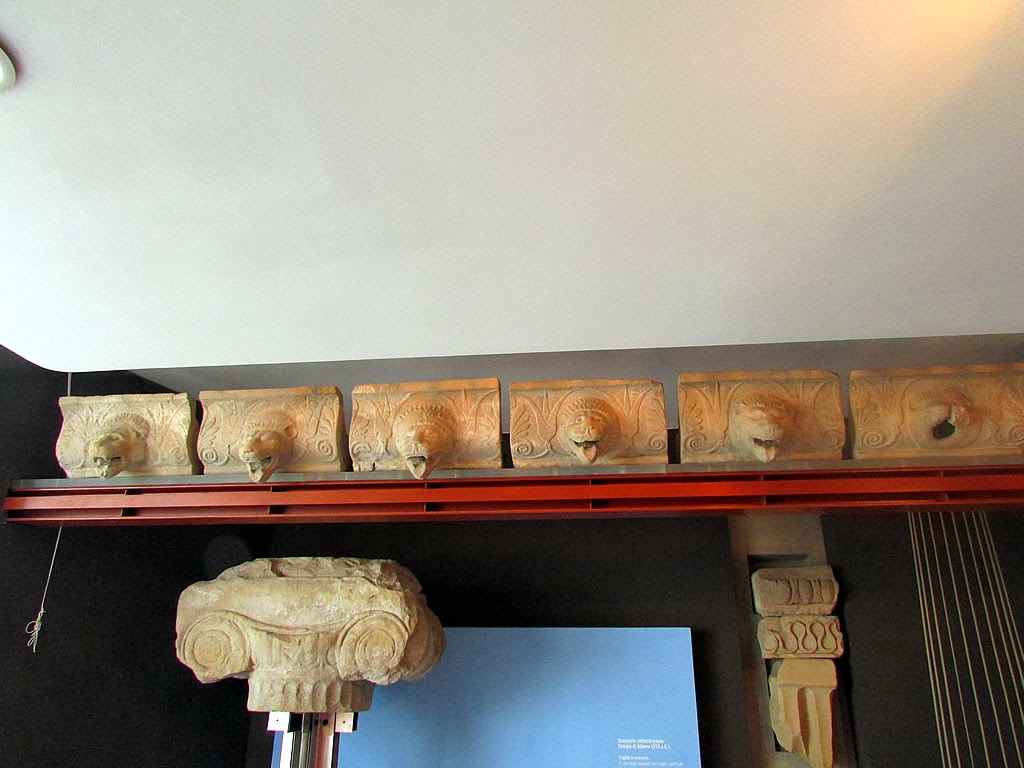
Overhead - Lion Head Drains Underneath - Ionic Capitol
Paestum Artifacts

Rooster Figure (couldn't resist)


