Sunday, 22 March 2015

A Couple of Walks

We joined a Spanish walking group today for a walk in the Valley of the Mills, which commenced in Arroyomolinos, which translates as millstream.  When we reached the parking area just prior to 9:00 a.m. there was nobody around and then suddenly a group of cars came driving up, they must have got together to car pool.  They were very welcoming even though we could barely understand each other.

There were over 30 people in the group, which surprised us.  Later on at a lunch break, a walker who could speak some English came up and explained that the group usually numbers around 50 walkers.

As there are various levels of fitness among the group, the line of walkers sort of strung out along the trail and temporary groups formed.  Since John and I are of the insane Canadian mentality, we found the pace a bit slow so we walked with the group at the front.

The people were really kind to us, they tried to show us things and some of them were picking wild asparagus which they handed to us to try.  The Spanish are into sharing food, at the lunch stop, they walk around and offer each other their snacks.  We were offered figs, licorice, candy, peanuts, cashews, chocolate, we opted for a few nuts but declined the remainder.

There is a stream which runs along the length of the valley we walked.  The Romans used the stream to turn mill stones to mill grain.  The Moors perfected the system, a series of channels were built to direct the water, the water then dropped down to turn the mill stones.  Everything then fell to ruin, a few of the mills have been restored and there are a few mill stones laying around.

At the end of the walk, which took about four hours, we expressed our thanks to the people we walked with and then took off for another walk, like we didn’t already have enough walking for the day.

The next walk we wanted to complete was just down the highway at the next town, called Alcuescar.  We no longer shy away from negotiating narrow streets, it does not alarm us in the least any longer so in we go.  We noticed that a lot of the streets are named after conquistadores.  We couldn’t seem to find the parking area so we just parked where the walk ends and used our GPS to get to the start of the walk, this worked out very well.

This walk went up over a small mountain through olive groves and then into pine and oak woods.  This particular area is loaded with more flowering plants than any other area we have walked, it also had a really pleasant scent due to the trees and plants.

The destination was an old Visigothic church, as there are very few Visigothic ruins in Spain, what there is, is generally in rural areas.  The Visigoths re-used Roman stones to build the church, and before the Romans, it may have been a temple to a CelticIberian goddess.  The Romans dedicated their temple to Ceres and Prosperpine.

The church has Visigothic horseshoe arches, which was the only reason it held any interest for us, but we could barely see inside to check out the horseshoe arches.  There appears to be restoration work starting on the Visigothic church.  We then had a road walk back to Alcuesca through cork oaks and olive groves, but we did not encounter a single car, the walk was approximately 9.5 km.

Large cork oak, cork is harvested every nine years

Arroyomolinos

Mill stone

Spanish walkers, they knew the route so we just followed them

Mill building where the grain was ground

Looking down the water shute

Remains of a water channel that leads to the shute

Montanchez Alcazaba

Gum cistus flower

View of the cork forest

Visigothic church

Saturday, 21 March 2015

Trujillo Part II

We finally got to finish our walking tour of Trujillo today.  This is our favourite town as it has so many historical buildings made of stone.  We returned to the Plaza Mayor, where we ended our walk a few days ago.  Plaza Mayor is huge and although it was cloudy with a bit of drizzle, many people were out having drinks and tapas in the Plaza.  It seems as though many Spanish are here for the weekend as most are carrying maps and taking photos.  According to our wonderful hosts in our accommodation, many from Madrid and Sevilla come for a weekend getaway from the city.

I will begin by quoting the information panel on the Pizarro Palace which is on the Plaza Mayor:

‘The shield depicts in a few scenes, the history of the conquest, including the arrival of the ships, the walls of Cuzco, together with the Incan Emperor Atahualpa and his chiefs; and is a dramatic reminder of the role Pizarro played in the conquest of the Incan Empire.’

The Pizarro Palace is somewhat run down and is a vacant building.  The panel also states that it was the home of Hernando, Francisco’s half-brother as well as Francisco’s daughter, Francisca Pizarro Yupanqui.  Francisca’s mother was the 18 year old Incan princess that was given to Pizarro.  We may visit the Pizarro museum to learn more about the Pizarro’s in Trujillo.  I don’t think Hernando lived here as he was sent to prison for killing Pizarro’s old business partner Almagro, I think I remember reading that Hernando lived in Castile after his release from prison.

Absolutely everything with the exception of bars and restaurants are open from 10:00 until 2:00 and then from 4:00 until 7:00, when we were on our walk the Pizarro museum and the Alcazaba were closed.  Luckily we went to the butcher shop prior to 2:00 to get our meat as he does not open after 2:00 on a Saturday.  Our usual severely limited Spanish vocabulary, supplemented with our hand signals always works out in the shops, although I wouldn’t want to do anything much more complex than food shopping.

After wandering through the streets on our walking tour, we walked up to the Moorish Alcabaza, where there are stunning views of the countryside.  After coming back down from the hilltop, we stopped at the Plaza Mayor for our usual refreshment.  Some places serve café in a china cup and saucer, others in a small juice glass on a china saucer, it seems totally random.

We then walked through the oldest portion of Trujillo where there are a lot of convents.  One of the convents is now the Parador.  There are interesting little buildings and streets everywhere and of course the storks have their enormous nests at the top of many buildings and towers.  John seems to have developed a stork fetish, as I always find him pointing his camera skyward at a stork nest.  If I had no input into the photos chosen for the blog, it would be a blog of storks.

Palace of the Pizarro

Shield detail on Palace of the Pizarro

Plaza Mayor

Palace of Carvajal Vargas

Alcazaba in backgrond (one stork pic that made the cut)

15th Century street

Gate of Coria

Alcazaba

View from Alcazaba


Gate of Santiago

Neat little stone buildings everywhere

Tower of the Pin

Buttresses from the Franciscan Convent of San Pedro

Merida Part II

As we are acclimatized to warm temperatures, it was fairly chilly in Merida.  The weather has turned cloudy and cool with the odd shower.  By the time we were finished at the museum we were in dire need of a café con leche; however, the area immediately outside the archaeological site and the museum is heavily geared toward tourists, to the point where everyone is accosted on the street with people waving English language menus in one’s face.

We took off on our walking route to get away from the area and stopped in for a café at a normal bar/bake shop a couple streets away which is frequented by locals.  After a much appreciated café we continued on our walking route.

There are so many excavated Roman ruins in Merida, there is even Roman snow wells.  These are three tanks built into the ground which are connected by channels and used to store snow.  Then it was onto the Forum which was located at the intersection of the two main streets in any Roman city, where the decumanis and the cardo intersect.  The Forum was a public space which always held a temple at the back wall.

The portico, built in the 1st century AD has been restored.  The colonnade, with Corinthian capitals, is decorated with huge medallions with heads of Jupiter, Amnon and Medusa along with caryatids, which the Romans copied from the Greek Acropolis in Athens.

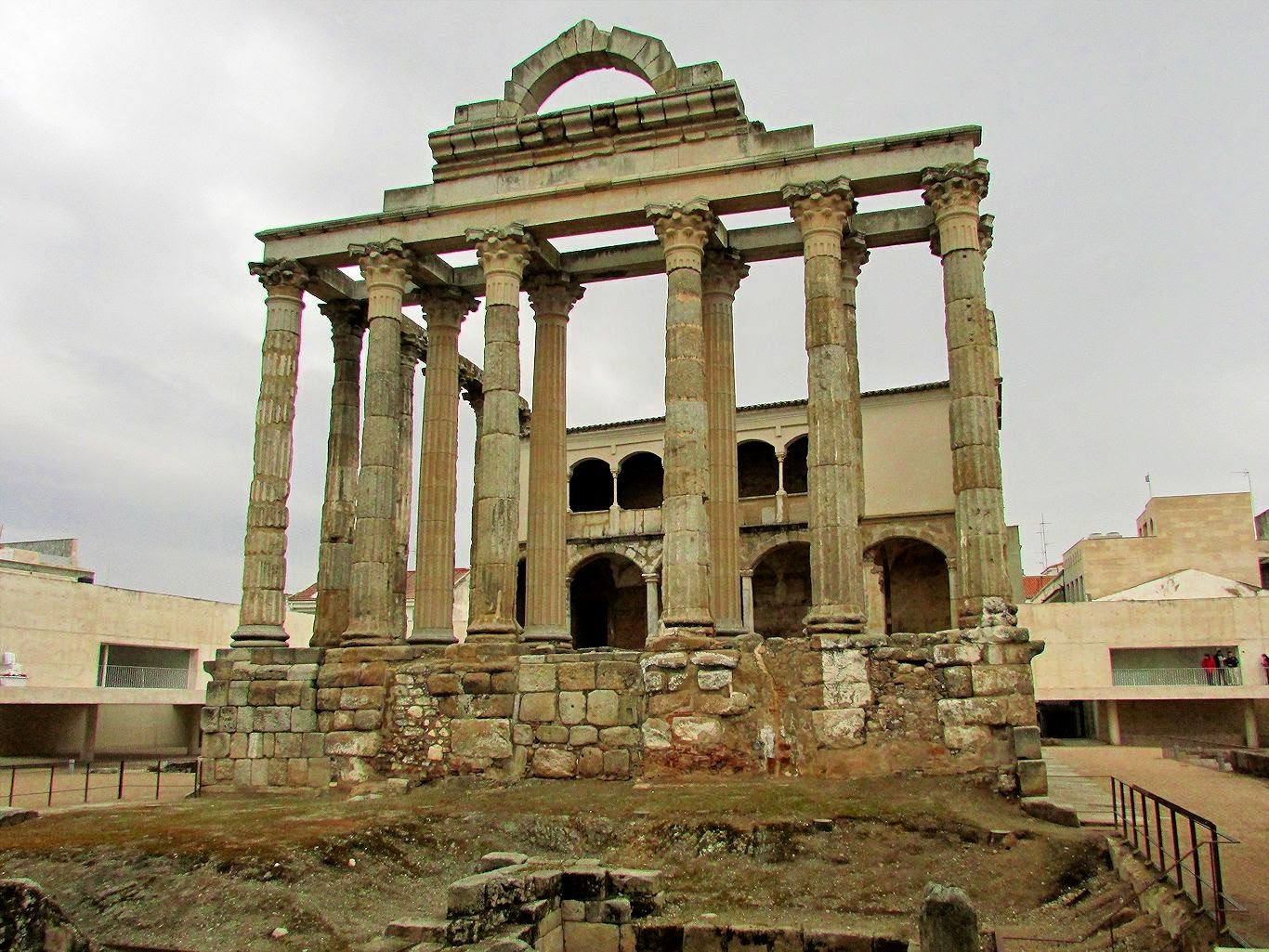
The Temple of Diana, which is actually a temple to the Imperial cult, was built of granite in the usual Roman style with a high podium, frontal facade with an interesting semi-circular pediment, porch, and surrounded by a colonnade.

The Moors built a palace on the site and altered the temple, the high podium seems to have been utilized for defensive purposes as this is a high point in the city as well.  It may have housed the governor until the Alcazaba was built.

In the 15th century, a Renaissance palace was built inside the temple, there is evidence of both Roman and Visigothic building materials in the construction.  The palace looks absolutely horrific inside the temple, but it did aid in preserving the temple.  It is a real mishmash of cultural building styles, with both Gothic and Mudejar elements in a Renaissance Palace inside a Roman temple along with Visigothic columns and capitals.

Our walk then took us to the ruins of a large Roman villa, located outside the Roman city walls, it is referred to as Mitre House.  The design follows the usual large domus as we have seen in Italy, with an atrium, colonnaded courtyard, triclinium, cubiculum, Roman wall painting etc.

We were then off to the river and since it was after 3:00 we had lunch on a park bench near the Roman bridge.  After a walk along the river we crossed the modern Lusitania bridge, walked along the river on the other side and then crossed over the Roman bridge which is only open to foot traffic.  The Roman bridge has been heavily restored over the centuries - in the 17th century, they used granite blocks from the theatre to rebuild the bridge.

The Moorish Alcazaba, built in 835 AD, sits on a hill overlooking the Roman bridge.  The Alcazaba is the only Moorish building that has survived in Merida, although excavations have revealed other buildings from the Moorish period which were built over Roman and Visigoth buildings, utilizing building materials from those periods.  The Alcazaba had 25 towers at one time, some were built after the Christian reconquest.

The most interesting feature in the Alcazaba, is the only surviving Moorish building within the walls, an underground cistern with double stairways leading down to the water tank.  It is poorly lit and after coming in from the bright light outside it was practically impossible to see our way down the irregular stone steps.  But we headed down and by the time we got close to the bottom we could at least see the way.  There are some wonderful Visigothic pieces used in the construction of the cistern, they look totally out of place as they would have been used in some important Visigothic building.

We then walked to the Visigothic museum which is housed in an old church.  There was nobody there but the attendant, who stood high up in the former alter area at the front and watched us the whole time we were there, which was a bit creepy.  I think we would have had quite a time pilfering a slab of marble, so I don’t really know why she took up her position.

The Visigothic museum was a total gem, loaded with Visigothic pilasters decorated with plant motifs, clusters, cane patterns and fruits.  There was also display cases with pottery, jewellery, tools and utensils etc.

Feeling rather saturated at this point we headed for the Plaza de Espana and had a café con leche at a sunny table in the plaza.  Then it was off to the aqueducts, there were three sets of aqueducts bringing water into Merida during Roman times.  The aqueducts carried water from reservoirs and springs outside the city.  The Romans were accomplished dam, aqueduct and water tower builders for the distribution of fresh water to the city.

Finally we reached our last stop, the Roman Circus, which was the stadium used for chariot races.  The circus seated 30,000 spectators and had six bays on each side of the parade entrance which held the charioteers.  The entire ground plan of the circus is visible today, which is quite rare.  The area in the middle is called the spina, which was richly decorated.  The chariots would run seven laps around the spina with the finishing lines at either end of the spina.  There is access to the whole circus area so we walked around the spina.

We then walked back to the parking lot and drove back to Trujillo.  We plan to complete our walking tour of Trujillo today and have a bit of an easier day.

The Forum

Temple of Diana

Temple of Diana with the Renaissance building stuck into the cella

Mitre House Courtyard

Moorish cistern with Visigothic pilasters

Stairway leading down to the cistern

Visigothic artifacts in the museum

Visigothic pilaster in the museum

Roman Los Milagros Aqueduct

Beautiful bird near the aqueduct

Los Milagros Aqueduct

Rabo de Buey-San Lozaro Aqueduct

Roman Circus

Friday, 20 March 2015

Merida

Merida is overwhelming, it is loaded with incredible Roman ruins as well as Visigothic artifacts and a Moorish alcazaba.  We followed an excellent 11.5 km walking tour that is in our Extremadura walking book, but we spent so much time looking at ruins and combing through the museum, that it took us eight hours to finish the walk.

We started out at the wonderful amphitheatre which was inaugurated in 8 BC.  Amphitheatres were used to stage the gruesome forms of entertainment that appealed to the Romans.  There were animal fights, fights between gladiators and animals and fights between gladiators.  The Spanish tend to bombard the visitor with information, which is really great.  There are small information boards everywhere and quite a few had descriptions in English as well.

The floor contains a large cross-shaped ditch, archaeologists believe it was likely boarded over, but was used to store the animal cages and stage props.  There are some interesting rooms off of the long passageways that lead into the arena.  They may have been used by the gladiators or the wild animals may have been kept in these rooms.

We then visited the theatre which is very close to the amphitheatre, the theatre was inaugurated sometime between the 16 and 15 BC.  The theatre is spectacular, it has a stunning stage facade which was put up in 105 AD, other alterations continued between 333 and 335.

The columns of the facade are of blue tinged marble which sat on white bases, the Corinthian capitals are also white.  The architrave above is decorated with egg and dart and other lavish decoration.

Between the columns were huge marble statues of Ceres, Pluto and Proserpine as well as several statues that were likely the emperor and his relatives.  The statues sitting in the facade are all reproductions, the originals, many sans heads, are in the museum.  This was quite the complex, behind the theatre, there was a peristyle courtyard and porticos.

As the Christians viewed theatrical performances as immoral, the theatre was abandoned, fell into ruin and filled with earth.  Only the upper section of seating was visible until archaeological excavation began in 1910.

We then moved on to the National Museum of Roman Art.  This is an excellent museum with outstanding displays in a wonderful brick building.  The collection is great, they have unearthed just about everything imaginable.  We will post some photos of just a few of the great finds in this museum.

We will have to continue with Merida in tomorrow’s blog as we are done-in for the day and there is too much to deal with in one blog post.

Amphitheatre

Passageway in the amphitheatre

The stage facade of the theatre


Detail of the ornamentation on the architrave


Statue of Ceres in the museum

Depiction of Medusa from the portico in the forum, flanked by caryatides

Bull's Head from the arch of a building in the forum

Chicken whistle, seriously

Fragment of a lamp, depicting Bacchus

Mosaic of the Charioteers